
Is planet Earth in danger?
Are we in danger?
Unfortunately, yes. This is a fact that everyone denies, ignores, or doesn't understand.
I will explain this logically and based on current events.
The explanation divides the danger into four types:
1- Cosmic danger - based on the movement of galaxies, planets, and asteroids, their interactions with each other, and extraterrestrial beings about which we know nothing so far.
2- Earth's danger - based on the conditions and interactions of the planet we live on.
3- Human-induced danger - based on the condition and actions of humans on and within planet Earth.
4- Evolutionary danger - based on the stage of development humanity has reached.
Before explaining, we must understand that the dangers we encounter when interacting with planets or nature develop gradually, but they intensify with each subsequent occurrence, doubling the risk each time.
1- Cosmic Danger - Based on the movement of the galaxy, planets, asteroids, and dust
I've always wondered where we are in the galaxy. The latest scientific findings indicate that our solar system is located in one of these arms (the Orion Arm), far from the crowded center.
(Illuminated by a green dot)
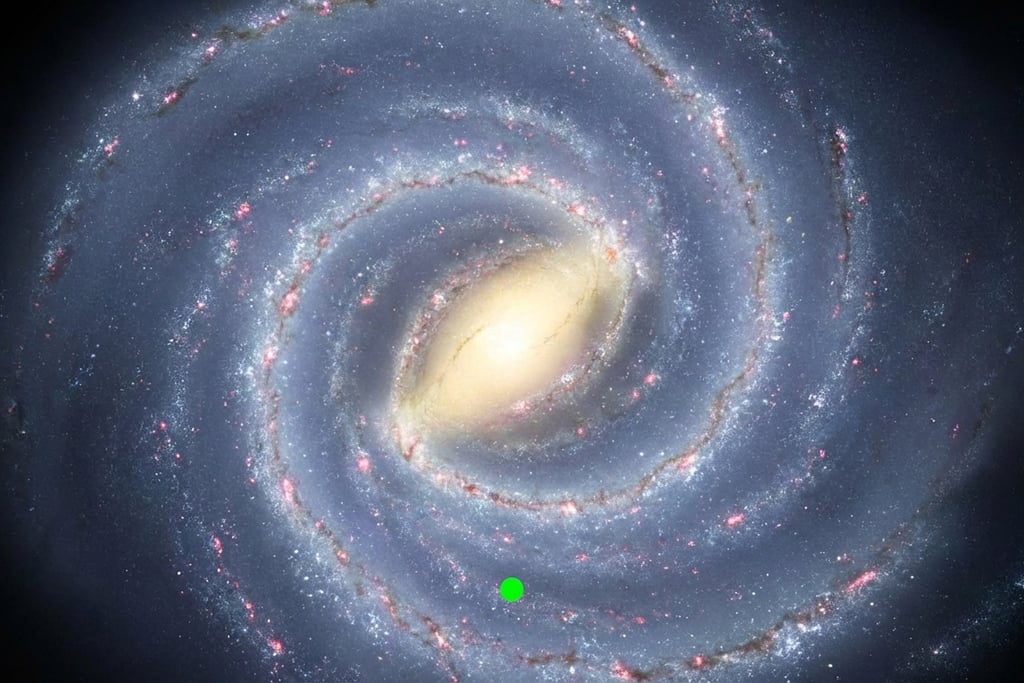
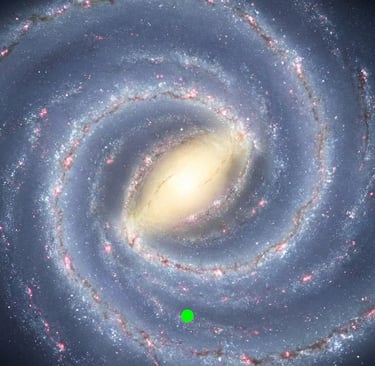
If this is true, then we are about to see sights that humanity has never seen before during the next 50 years - huge planets close to us that we pass by, huge rocks, a group of rocks passing by quickly, which happens every night if we focus our gaze at the sky at night, we will see things that shine, appear and disappear suddenly from far and near, they are comets.
(The sky will never be the same again).
After this information about our location, we can all agree that we are nothing but a speck of dust living in this galaxy. Just as we live on this humble planet in this galaxy, there are small and large planets and asteroids that swim with us in the same current and have their own movement and laws, some fast, some slow, and some stable. This matter in itself is the greatest danger to humanity because we do not know when a comet or a small asteroid will come and collide with the Earth. Therefore, we must protect the human race from extinction, no matter what it costs, by distributing humans on other planets. It is our life with its beautiful and wonderful history, the likes of which we have not found in the universe so far.
(Our mission: To ensure the continuity of life).
A. Synchronization Speed - Based on Planetary Motion Around the Galaxy:
Is there a scale for "synchronization speed"?
In astrophysics, we don't use the term "synchronization" in its literal sense (like synchronizing clocks). Instead, we use a scale called the Local Standard of Rest (LSR).
What is the LSR? It's an imaginary point in space moving in a perfect circular orbit around the center of the galaxy, based on the average motion of all the stars in our neighborhood.
The Sun's "synchronization" speed: The Sun (and Earth) move at approximately 230 kilometers per second (km/s) around the center of the galaxy. However, we are not perfectly "synchronized" with the perfect circular orbit; we move slightly faster and are slightly tilted towards the galactic center.
(Our mission: To ensure the continuity of life).
B. Wave-like Motion: Vertical Synchronization
Earth doesn't orbit the galaxy in a flat line like a track, but rather moves as if on a swinging or wave.
Vertical Oscillation: We ascend and descend through the galactic disk (the star-dense region).
Timescale: The solar system takes about 230 million years to complete one orbit around the galaxy (a cosmic year), but we ascend and descend through the galactic disk every 30 to 35 million years.
Dangerous Synchronization: Some scientists believe that this vertical synchronization (when we pass through the heart of the crowded galactic disk) exposes Earth to stronger gravity and cosmic radiation, which may be linked to some of the major extinctions in Earth's history.
C. What affects our rotation speed around the galaxy?
Here we arrive at a major physics puzzle. According to Newton's laws, stars farther from the galactic center should be slower than those closer to it, but reality has shown that we all move at almost the same speed.
Galactic Rotation Curve: Measurements have shown that the speed of stars remains constant (around 200-250 km/s) no matter how far we are from the center.
The Dark Matter Effect: This seemingly illogical "synchronization" of speeds is what led to the discovery of dark matter. If there weren't this hidden matter holding the galaxy together, the Sun and Earth would have been flung apart into deep space due to their immense speed.
D. Does this speed change?
Yes, but very slightly, so much so that we humans don't perceive it:
Galaxy Arms: When we pass through the galaxy's spiral arms (high-density regions), our speed slows down slightly and then speeds up again upon exiting, much like a traffic jam.
Interaction with Other Galaxies: The Andromeda Galaxy is approaching us, and its gravity microscopically affects the synchronization of our galactic motion.
D - Summary: The Cosmic Scale
If we want to measure our "synchronization," we use:
Orbital Velocity: V (approx. 230 km/s).
Oort Constants (A & B): These are mathematical measures used to describe how the speed of stars changes based on their distance from the center.
Occurrence Frequency: The rate at which we ascend and descend through the disk of the galaxy.
With a touch of brilliance: Imagine the galaxy as a giant "record" and Earth as the needle playing on it. We don't just rotate; we wobble up and down, maintaining a constant speed thanks to a "cosmic glue" called dark matter.
(What you read above is the latest scientific findings, and this is all we know. Our knowledge will only increase by leaving this planet and exploring this universe.)
--------------------------------------------------------------------------------------------------------
2 - The Danger to Planet Earth:
The reactions on planet Earth are occurring gradually, each time becoming more intense than the last, in terms of heat and cold, volcanoes, oceans, and the ice at the North and South Poles.
These phenomena interact independently, with the reactions escalating each time. There are no solutions, and it is impossible to find a solution other than leaving the planet and creating a new civilization on other planets.
Anyone can research this matter, specifically volcanoes, their reactions, and the percentage of ice melted over the past 30 or 100 years.
You will be shocked by the number of volcanoes that have become more active and the intensity of their reactions, volcanoes that have not erupted for hundreds of years. And thousands of years have begun to become active in the last 20 years.
We must not forget the amount of ice that is continuously melting—trillions of tons—in the oceans of the North and South Poles.
And the seas have begun to bring marine animals from their depths to the shores, such as whales that are now dying on beaches, and other animals laden with plastic, in addition to the waste that has begun to accumulate in the middle of the seas, reaching the size of countries, and along the coastlines.
Over the past 10 years, transparent marine animals have begun to appear on the surface of the seas. These creatures are supposed to live on the seabed, not at the surface, which means that their habitat has become uninhabitable, or that oxygen has run out in their habitats, so they have begun to flee to the surface, or perhaps there is another reason we do not yet know.
If we start talking about heat and cold, you'll find a tangible difference, felt seasonally in the intensity of the heat and the severity of the cold. If you don't feel it, it's because you're always protecting yourself under the air conditioner and heater at home, at work, while shopping, or in the car. These variations make life on Earth very difficult.
A - Bacteria, viruses, and fungi: The entire world is built on these living organisms. Just as they are essential for our lives, they are also the deadly danger that threatens us. The variation in temperature causes them to become active and adapt, becoming stronger than before. And the stronger they become, the more dangerous they pose to human life. As happened with the coronavirus, this is just the beginning. Other organisms with even stronger effects will appear, and we will wish they were like the coronavirus because they will be much more difficult and powerful.
--------------------------------------------------------------------------------------------------------
3 - The Human Threat:
The Human Condition: Human beings are ill-equipped to withstand the dangers they face. Our eating, drinking, and movement patterns on this planet differ from those of previous civilizations. The ease of access to food and the relative lack of movement compared to past civilizations all impact humanity's resilience to impending dangers. Many will perish due to their inability to endure the harsh conditions ahead.
This report details the direct impact of human actions, not only on death itself but also on the path to death caused by natural disasters.
"Today's comfort is tomorrow's weakness."
When we talk about the "direct impact" of natural disasters, we're not just talking about deaths, but also the upheaval of millions of lives; from the loss of homes (displacement) to the destruction of livelihoods and long-term psychological and health consequences.
Here's an analytical look at how natural disasters directly impacted people between 2018 and the end of 2025:
A. The Displacement Crisis (Largest Numerical Impact)
During these years, natural disasters became a major cause of internal displacement, sometimes exceeding the numbers of people displaced by war.
2018-2021: The average number of people affected annually was around 90 million. Cyclones in Southeast Asia and wildfires in Australia and California were the main reasons for the evacuation of entire cities.
2022 (The Year of the Floods): In Pakistan alone, floods directly displaced more than 8 million people, leading to a housing and public health crisis that has persisted for years.
2024–2025: In 2024 alone, approximately 167 million people were affected by disasters. In 2025, a record 45.8 million new internal displacements due to disasters were recorded, driven by floods in China, wildfires in Los Angeles, and an earthquake in Myanmar.
B. Direct Impact by Type of Disaster
1 - "The Silent Killer": Heat Waves (2021-2025)
Heat waves are no longer just "hot weather"; they now directly affect:
Physical Capacity: The collapse of power grids in major cities (as happened in Asia and Europe in 2024), leading to the shutdown of hospitals and air conditioning systems.
Employment: The loss of millions of working hours for those who work outdoors, directly impacting the income of poor families.
2 - "Earth Shock": Earthquakes (2023 & 2025)
Turkey and Syria Earthquake (2023): Destroyed over 300,000 buildings, leaving millions homeless overnight, with psychological effects (post-traumatic stress) still haunting survivors.
Myanmar Earthquake (2025): Devastated the infrastructure of remote cities, cutting off thousands of people from medical supplies for weeks.
3 - "Swallowing Cities": Floods and Hurricanes
The scenario of "submerged cities" was repeated in Brazil, Spain, and China (2024-2025), where people lost all their material possessions (home, car, savings) in moments.
C. Impact on Food and Water Security
Between 2018 and 2025, successive disasters led to:
Crop destruction: Droughts in East Africa and Brazil drove up global food prices, leaving millions of families unable to secure their basic meals.
Water pollution: In each flood (such as Libya in 2023), sewage mixed with drinking water, directly exposing survivors to deadly intestinal diseases.
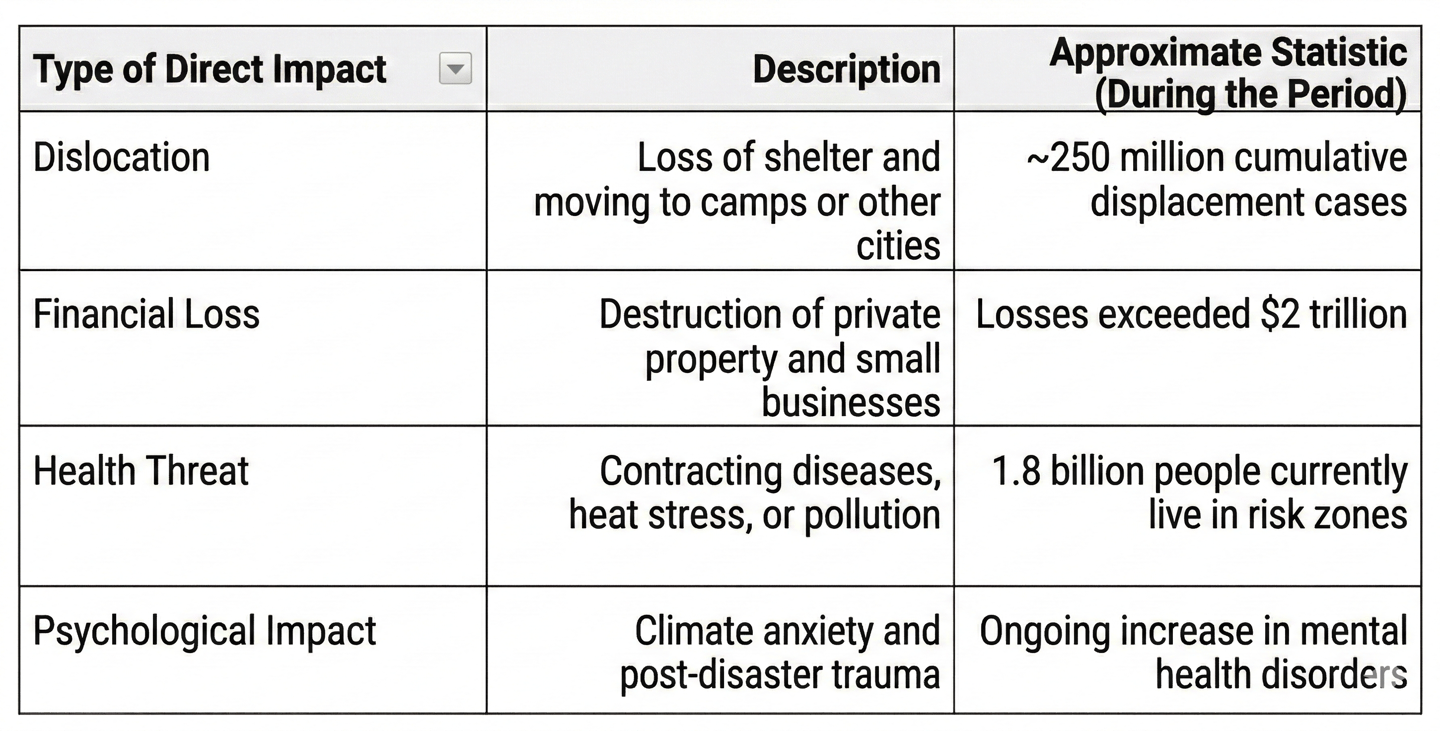
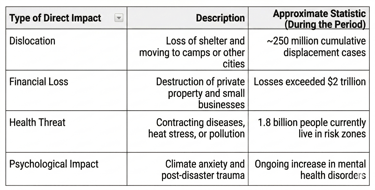
Natural disasters in recent years (especially 2024-2025) are no longer passing events, but have become a "daily reality" that is changing the geography of human habitation and forcing societies to readjust to a more violent planet.
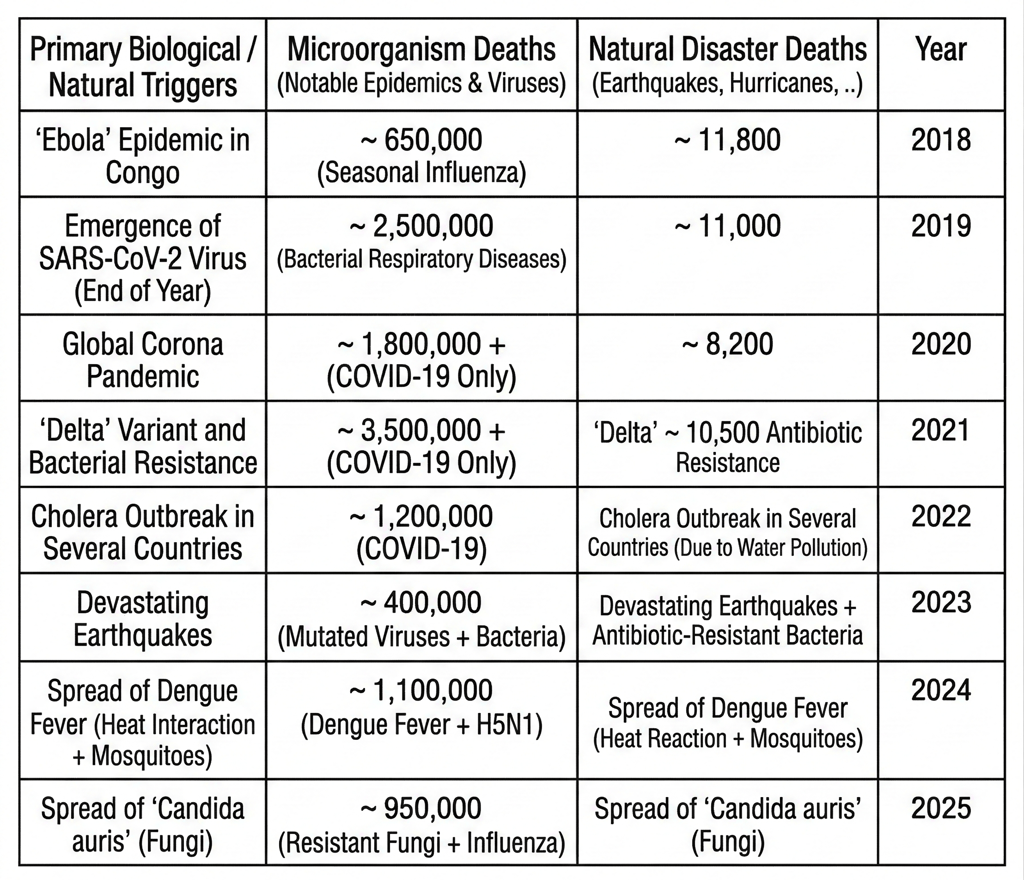
This is an approximate table of deaths that could be recorded from 2018 to 2025.
--------------------------------------------------------------------------------------------------------
3 - Human actions on planet Earth:
A - The dangers of products
Human actions on this planet and the stage of development and solutions it has reached are very great, but this development has negative aspects due to the need built on consumption. The principle of working on the repetitive consumption system for the same need due to tastes, differences, or new solutions has made man the first consumer on the planet. The tragedy is that needs that have become useless or useless have become waste that is thrown into the seas and underground or burned, and few countries rely on recycling, and even recycling has not become useful or a worthwhile income for those who work in it, so it has become a burden on the entire planet - such as - plastic / paper / wood and other products. Some tell you that these products decompose over time, but they do not ask themselves what they will do to the planet and humanity during the decomposition periods. The products that have become waste are many times greater than the current human population.
B. Gas Risks: The Unseen Threat
The risks fall into two parallel categories that threaten the stability of the planet and human health:
Global Warming (Climate Change): Gases such as carbon dioxide (CO2) and methane (CH4) act as a blanket that traps heat. By the end of 2025, the world recorded its highest level of carbon concentration (425.7 parts per million), leading to accelerated ice melt and rising sea levels.
The Direct Health Threat: Air pollutants (such as nitrogen oxides and particulate matter) have caused an increase in asthma, cancers, and heart disease. A study published in January 2026 confirmed that emissions from the plastics industry alone could double their harmful health effects by 2040.
Ocean Acidification: The absorption of CO2 by the oceans makes them more acidic, threatening coral reefs and global food security, which depends on the seas.
C. Human Progress: Have We Begun to Change Course?
Despite the alarming figures, humanity has made unprecedented technological and legal progress up to the beginning of 2026:
Peak Emissions (2026): Projections indicate that 2026 will be the year in which global carbon emissions peak and then begin to decline for the first time in modern history, thanks to the massive expansion of clean energy.
Renewable Energy Explosion: Solar and wind power will cover more than 14% of total global energy by 2025, with 700 gigawatts of new capacity added in just two years.
Electric Transportation Revolution: One in four cars sold worldwide is now electric, reducing direct dependence on oil.
Carbon Capture (CCS) Technologies: We have moved from the experimental stage to building massive factories capable of extracting millions of tons of carbon directly from the air and storing it underground!
Outlook for the next 20 years (2026-2046)
This period will be the true test of humanity's ability to adapt:
2030-2035: Renewable energy is expected to become the primary source of electricity globally, surpassing coal and gas. Many countries will achieve carbon neutrality in their electricity sector.
2040: The near-complete phase-out of internal combustion engines (gasoline and diesel) in most developed countries and China, and the emergence of the first generation of hydrogen-powered "green aircraft."
2045-2046: The target date for major countries like Germany and California to achieve "net zero" emissions. By this time, nuclear fusion technologies will have entered their initial pilot phase as the ultimate clean energy solution.
- The remaining challenge: Despite all the solutions, the planet will continue to warm at a rate that may temporarily exceed 1.5 degrees Celsius. This means that the next two decades will see continued heat waves and floods, requiring massive investments in adaptation and the construction of resilient cities.
What if one of these processes fails? What will we do then?
D. The Dangers of War: Wars are considered a man-made "natural disaster," but their effects sometimes surpass those of the most powerful earthquakes because they not only destroy the present but also plant "landmines" in the future of the planet and humankind.
Human Impact: Displacement and the Age Gap
During this period, the world witnessed major conflicts (Ukraine, Sudan, Gaza, Yemen, Ethiopia) that led to catastrophic results:
Record levels of displacement: By the end of 2025, the number of forcibly displaced persons and refugees worldwide exceeded 130 million. This mass movement puts pressure on natural resources in host regions and creates housing and health crises.
Food Security: Wars (especially in Ukraine and Sudan) disrupted global food supply chains. In 2024-2025, more than 300 million people suffered from acute food insecurity as a result of the cessation of grain exports or the destruction of agricultural land.
The Carbon Footprint of Armed Forces (The Hidden Environmental Danger)
This aspect is often overlooked, but militaries are among the planet's biggest polluters:
Massive Emissions: Military and war emissions are estimated to account for approximately 5.5% of total global emissions. If militaries were considered "states," they would be the fourth largest emitter of carbon in the world.
Destruction of Vegetation: The use of weapons and military fuels contaminates the soil with heavy metals (such as lead and mercury) that remain in the ground for hundreds of years, rendering agriculture impossible.
"Ecocide"
This term gained significant prominence in 2024 and 2025 to describe the deliberate destruction of the environment as a weapon of war:
Water pollution: Bombing desalination plants and water reservoirs leads to the spread of epidemics (such as cholera, which made a strong comeback in conflict zones in 2025).
Air poisoning: Explosions and fires at oil facilities release clouds of toxic chemicals that do not recognize borders, but rather travel on winds to pollute neighboring countries.
The Impact of Sound Power from Missiles and Tanks on the Earth and Soil Erosion
Sound Power: From Noise to Destructive Energy
Sound is not merely a nuisance; it is also air pressure that travels through solid objects.
Missiles: Missile launches (especially ballistic or large rocket launchers) generate sound levels exceeding 180 to 200 decibels. This power is sufficient to shatter nearby concrete structures and generate pressure waves that penetrate the Earth's interior.
Tanks: The massive engines and movement of tracks generate low-frequency vibrations (infrasound). These frequencies are sometimes inaudible to the human ear, but the Earth "feels" them as continuous micro-earthquakes.
Impact on Soil Structure (Bound Breakdown)
Soil is not a single solid mass, but a mixture of particles, air, and water. Strong vibrations lead to:
Soil Liquefaction: In areas with moist or sandy soil, violent vibrations from explosions or the movement of heavy vehicles cause the soil to lose its firmness and become liquid, leading to the collapse of any structures built upon it.
Destruction of Porosity: Acoustic and mechanical pressure compresses soil particles and eliminates air spaces, killing microorganisms and rendering the soil "dead" and unable to absorb water.
Soil Erosion and Landslides
Here is the direct link between "sound power" and "erosion":
Slope Breakdown: In mountainous regions, the sound waves generated by explosions act like a "hammer," breaking the fragile bonds between rock and soil. This makes slopes susceptible to immediate collapse or erosion with the first rainfall.
Accelerated Erosion: When soil is broken down by vibrations, it becomes extremely "fragile." The wind generated by the explosions (overpressure) displaces the fertile topsoil, leaving the land bare and vulnerable to rapid water erosion.
Microscopic Cracks and Geological Impact
Research conducted in conflict zones between 2018 and 2025 has shown that:
Repeated vibrations cause microscopic cracks in subsurface rock layers, which can alter groundwater flow or dry up natural water sources.
The shock waves of heavy missiles can trigger "minor seismic activity" in already sensitive geological faults.
- Scientific fact: Large explosions in recent wars have been recorded by seismological observatories as "earthquakes" with a magnitude of 2 to 3.5 on the Richter scale. This demonstrates that war is not merely a confrontation above ground, but a physical assault on the Earth's crust itself.
When the sound of the explosion subsides and the smoke clears, the "silent chemical warfare" begins, unseen by anyone. Missiles and shells are not simply exploding chunks of metal; they are "toxic chemical laboratories" that release their contents into the heart of the soil.
Here is a report on the chemical residues of weapons and their poisonous effects on the land over the years:
Organic Explosives: Poisons That Don't Die
The materials that make a rocket explode (such as TNT and RDX) are completely alien to nature and terrifyingly chemically stable:
Chemical Stability: These materials do not decompose easily; TNT, for example, can remain in the soil for more than 80 years without losing its toxicity.
Carcinogenicity: These materials are considered "proven carcinogens." When absorbed by the soil, they seep with rain into groundwater, and from there into drinking water and crops, causing genetic mutations and chronic diseases in the population even decades after the end of the war.
Heavy Metals: “Evil Spirits” in the Soil
Every shell or bullet contains heavy metals injected into the ground upon impact:
Lead, mercury, and chromium: These metals never break down. They remain in the topsoil, inhibiting plant growth or being absorbed in high concentrations by fruits and vegetables.
Brain Poisoning: Lead from projectiles in conflict zones (such as those observed in Iraq, Syria, and Ukraine between 2018 and 2025) has led to increased rates of poisoning among children, affecting their mental and physical development.
Rocket Fuel (Perchlorates)
The modern rockets we saw used extensively in 2024 and 2025 rely on solid or liquid fuel containing perchlorates:
Thyroid Gland Destruction: This substance dissolves in water with astonishing speed and reaches crops. When it enters the human body, it prevents the thyroid gland from absorbing iodine, causing widespread hormonal imbalances in communities living in bombed areas.
White Phosphorus and Acidic Effects
The use of white phosphorus (as occurred in the 2023-2024 conflicts) does more than just burn people:
Soil acidification: Phosphorus reacts with atmospheric oxygen to produce phosphorus pentoxide, which, upon contact with soil moisture, transforms into phosphoric acid. This drastically alters the soil's pH, killing microorganisms essential for soil fertility and rendering the soil bio-scorched.
Case Study (2025): “Dead Earth”
In reports submitted in late 2025 on conflict zones in Eastern Europe and the Middle East, scientists found that some farmland contained cadmium and lead levels 100 times higher than internationally permitted limits.
-A sobering conclusion: A missile that explodes in seconds leaves behind a “legacy of toxins” that will require hundreds of years and complex cleanup operations (costing billions of dollars) to make the land habitable again.
--------------------------------------------------------------------------------------------------------
4 - Evolution - Based on the state of development humanity has reached and the risks that accompany it.
The state of development humanity has reached on this planet in all aspects is unprecedented in human history since its existence on this planet.
State of Technological Development (Achievements)
Humanity has achieved breakthroughs that have transformed "science fiction" into daily reality, the most important of which are:
The Information and Communication Revolution: Access to human knowledge has become instantaneous. Communication technologies (5G and beyond) have eliminated distances and made the world a true "digital village."
Biomedicine and Genetic Engineering: Thanks to technologies such as CRISPR, we have become able to modify genes and treat previously incurable diseases, thus increasing human life expectancy and improving quality of life.
Artificial Intelligence (AI): Automating complex tasks, accelerating scientific research, and the ability to analyze massive amounts of data to predict health or climate crises.
Clean Energy: Advances in solar energy technologies and experimental nuclear fusion are paving the way for ending dependence on fossil fuels.
Risks of Technological Development (Challenges)
Every technological advancement carries with it a "tax" that could threaten human stability if not properly managed:
The Risk of Superintelligence: Concerns about losing control over autonomous systems, or their making decisions that conflict with human values, in addition to unemployment resulting from job automation.
Cybersecurity and Privacy: The world's digital transformation has made societies vulnerable to attacks that could cripple infrastructure (electricity, banks), with a complete erosion of individual privacy.
Genetic Supremacy and Classism: The risk of a gap emerging between "genetically modified humans" and "normal" humans, which could create a new kind of social inequality.
Lethal Autonomous Weapons: The development of weapons that kill without human intervention increases the risk of war and makes international accountability more difficult.
Summary: Critical Balance
We live in a time of "existential risk," where technology has the potential to save the planet or destroy it. True success is not measured by the complexity of the machine, but by our ability to establish ethical and legal frameworks that ensure progress serves humanity, not the other way around.
"Technology is a good servant, but a bad master."
All the information you have read above is merely a glimpse into the universe, the galaxy, planet Earth, and the evolution of humanity.
(And most people don't believe in disaster until they see it before their eyes.)